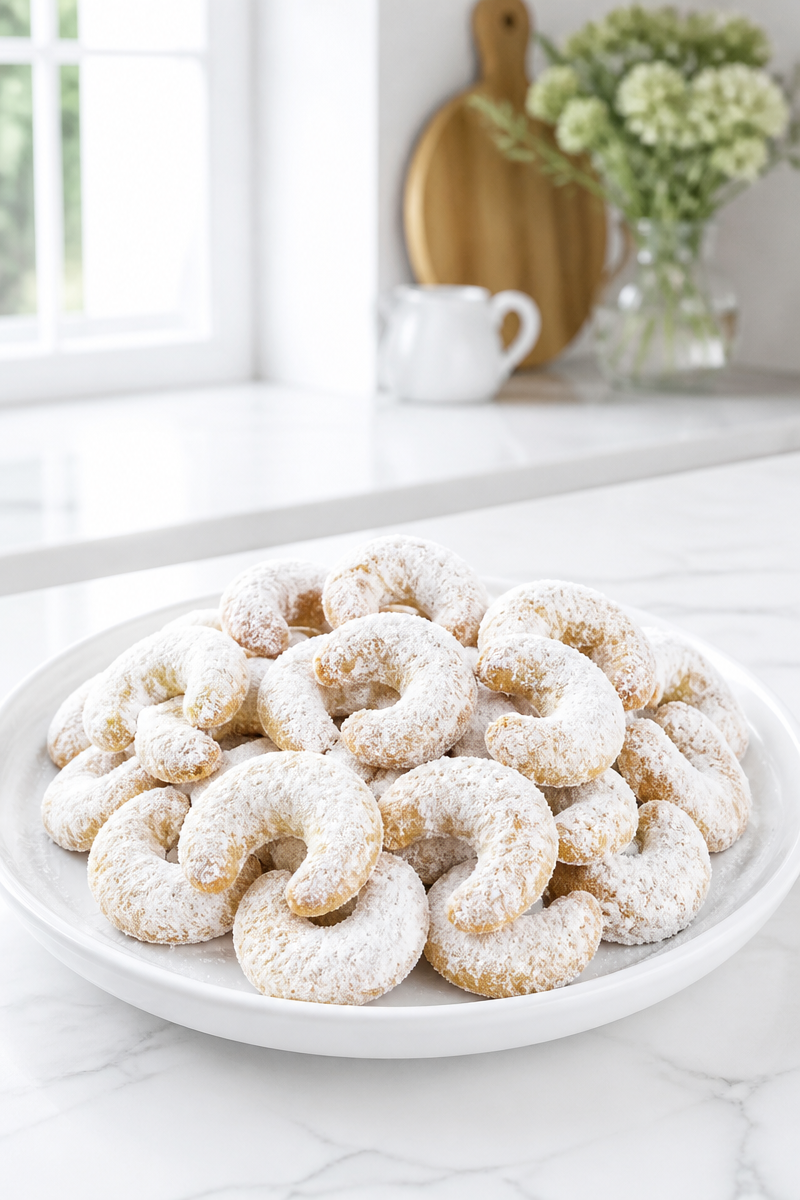
When I think of holiday baking that feels truly timeless, Vanillekipferl always comes to mind. These delicate Austrian crescent cookies are pure comfort, and they bring a soft, cozy feeling to any kitchen. They are the kind of Christmas cookie that makes people slow down, smile, and reach for just one more.
What makes this Austrian Vanillekipferl Christmas Cookie so special is its simple but rich dough. You get unsalted butter, egg, powdered sugar, vanilla bean seeds, salt, cake flour, finely ground almonds, and finely ground hazelnuts. Then, after baking, the cookies are coated in a sweet dusting of powdered sugar and vanilla sugar. The flavor is buttery, nutty, and gently sweet, with a warm vanilla note that feels elegant without being fussy.
The method is wonderfully easy, too. First, you mix the butter, egg, sugar, vanilla, and salt until creamy. Next, you add the dry ingredients and form a soft dough. After a short chill, you shape small crescents, bake them until lightly golden, and dust them while warm. Because the steps are so simple, this recipe is friendly for both new bakers and more experienced home cooks.
This cookie is perfect for holiday trays, cookie swaps, and quiet afternoons with tea or coffee. Also, since it keeps well for weeks, it is a smart make-ahead treat for Christmas gatherings, gift tins, and winter potlucks.
Why You’ll Love This Classic Austrian Vanillekipferl Christmas Cookie
- Simple ingredients: You likely already have most of what you need in your pantry or fridge.
- Rich holiday flavor: Butter, vanilla, almonds, and hazelnuts create a classic festive taste.
- Great make-ahead cookie: These cookies store well, so you can bake early and enjoy later.
- Beautiful shape: The small crescent shape looks elegant on cookie platters and gift trays.
- Comforting and tender: The texture is soft, crumbly, and melt-in-your-mouth delicious.
Butter Tips
Butter is the heart of this Austrian Vanillekipferl Christmas Cookie, so quality matters. Use unsalted butter and let it soften at room temperature until it feels pliable, not greasy or melted. That way, it creams smoothly with the sugar and helps create a soft dough. If your kitchen is cool, give the butter a little more time on the counter. However, do not microwave it into a puddle, since that can change the texture of the cookies. For the best flavor, choose a butter you enjoy eating plain, because its taste will come through in every bite.
Options for Substitutions
- If you need a nut swap, replace the ground almonds with more finely ground hazelnuts for a deeper, more toasty flavor.
- If hazelnuts are hard to find, use extra ground almonds instead, although the cookies will taste a little milder.
- If you do not have a vanilla bean, vanilla bean paste works very well, and it gives a lovely speckled look.
- If vanilla sugar is unavailable for dusting, mix powdered sugar with a small amount of vanilla extract or ground vanilla.
- If cake flour is not in your pantry, use all-purpose flour for a sturdier cookie, but the texture will be slightly less tender.
- If you need to avoid nuts, you can try a nut-free shortbread-style cookie recipe instead, since this recipe depends on nuts for both flavor and structure.
Watch Out for These Mistakes
One common mistake is using butter that is too warm. If the butter is melted or very soft, the dough may spread too much and become hard to shape. On the other hand, if it is too cold, it will not cream properly with the sugar. So, aim for softened butter that bends easily when pressed.
Another issue is skipping the chill time. The dough needs 1 hour in the refrigerator so it firms up enough to shape into crescents. If you rush this step, the dough can stick to your hands and lose its neat shape. As a result, the cookies may bake unevenly.
Also, watch the baking time closely. These cookies should be lightly golden on the bottom and edges, not deeply browned. Since they are small, they can go from perfect to overdone quite fast. So, check early, especially near the end of the first batch.
Finally, do not wait too long to dust them with sugar. The warm cookies hold the sugar best, and that sweet coating is part of the classic finish. If the cookies cool too much, the sugar will not cling as well. Therefore, roll or sift them while they are still warm but easy to handle.
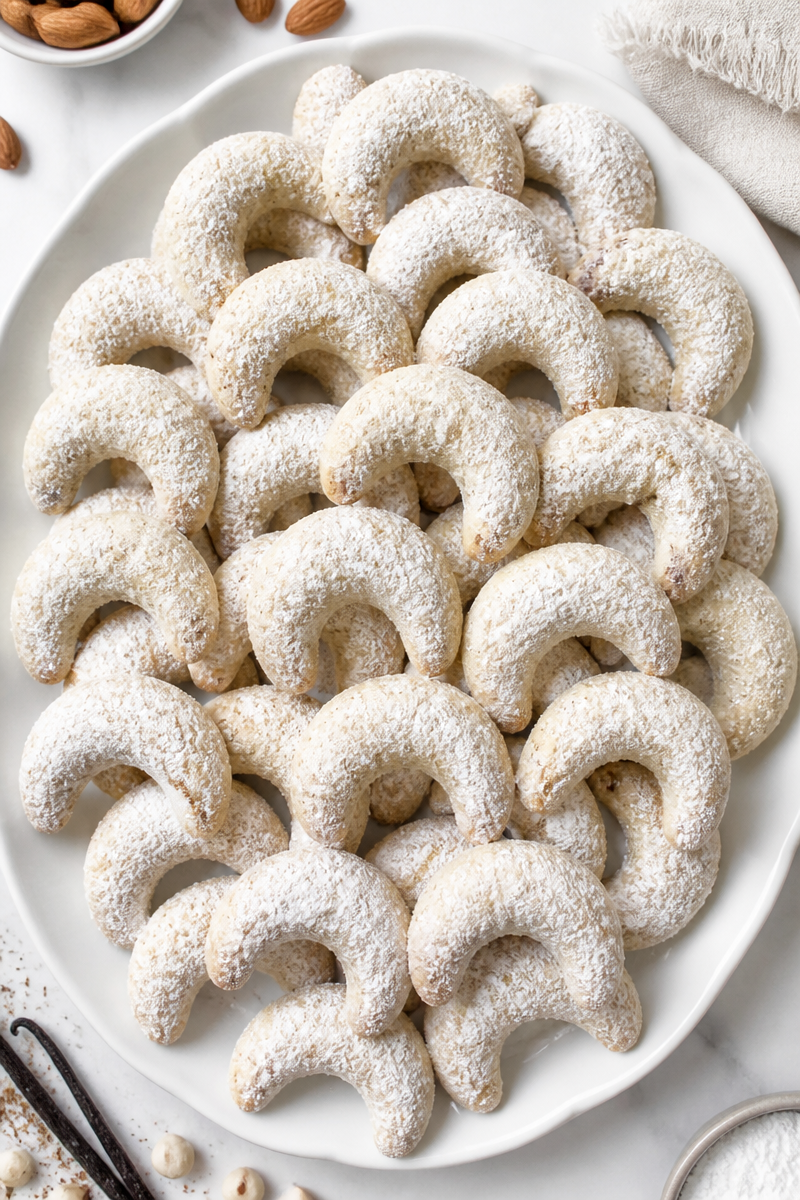
What to Serve With Classic Austrian Vanillekipferl Christmas Cookie?
These Austrian Vanillekipferl Christmas Cookies go beautifully with a hot cup of black tea, coffee, or cocoa, especially on a chilly evening. They also pair well with mulled wine, spiced apple cider, or a light dessert wine for holiday gatherings. If you want to build a dessert tray, add gingerbread, chocolate shortbread, or jam thumbprints for color and variety. Then, for a cozy afternoon treat, serve them with fresh fruit and a warm drink so the buttery vanilla flavor can really shine.
Storage Instructions
Store: Keep the cookies in an airtight cookie tin at room temperature for 3 to 4 weeks. If you want, you can also store them in the refrigerator for up to 7 days, although room temperature usually gives the best texture.
Freeze: Freeze the baked, cooled cookies for up to 3 months. Place them in layers with parchment paper between them, then seal well.
Reheat: For stovetop-style warming, let the cookies sit at room temperature until soft enough to enjoy, since they are not meant for true reheating. If you want a very light refresh in the microwave, warm them for 5 to 8 seconds only. However, be careful, because too much heat can melt the sugar coating.
Recipe Info
Preparation Time: 45 minutes
Cooking Time: 30 minutes
Total Time: 2 hours 15 minutes
Level of Difficulty: Easy to Medium
Servings: 90 cookies
Estimated Nutrition
Estimated nutrition for the whole recipe (without optional ingredients):
- Calories: about 5,400 to 5,900 kcal total
- Protein: about 85 to 100 g total
- Fat: about 340 to 390 g total
- Carbohydrates: about 520 to 590 g total
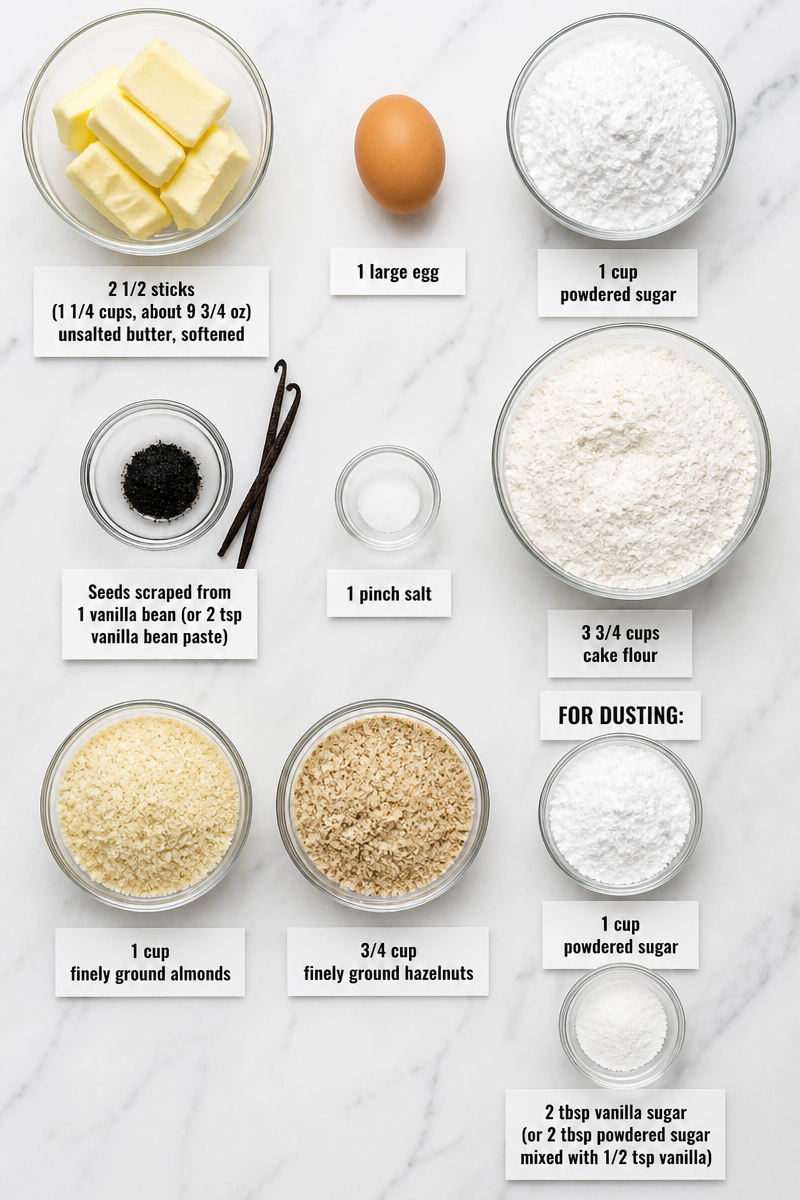
Ingredients
- FOR THE DOUGH:
- 2 1/2 sticks (1 1/4 cups, about 9 3/4 oz) unsalted butter, softened
- 1 large egg
- 1 cup powdered sugar
- Seeds scraped from 1 vanilla bean (or 2 tsp vanilla bean paste)
- 1 pinch salt
- 3 3/4 cups cake flour
- 1 cup finely ground almonds
- 3/4 cup finely ground hazelnuts
- FOR DUSTING:
- 1 cup powdered sugar
- 2 tbsp vanilla sugar (or 2 tbsp powdered sugar mixed with 1/2 tsp vanilla)
Step-by-Step Instructions
Step 1: Cream the Butter and Sugar
In a large bowl, beat the softened butter, egg, 1 cup powdered sugar, vanilla seeds, and salt with an electric mixer until the mixture looks smooth and creamy. This step helps build the soft texture that makes Vanillekipferl so tender.
Step 2: Add the Dry Ingredients
Add the cake flour, ground almonds, and ground hazelnuts. Mix on low speed, or knead gently by hand, until a soft and smooth dough forms. If the dough feels a little crumbly at first, keep going slowly, because it will come together.
Step 3: Chill the Dough
Wrap the dough well and refrigerate it for 1 hour, or until it is firm enough to shape. This resting time makes the dough easier to handle and helps the cookies keep their crescent shape while baking.
Step 4: Shape the Crescents
Preheat the oven to 365°F (180°C) and line 3 baking sheets with parchment paper. Then, pinch off teaspoon-sized pieces of dough and roll each piece into a short stick about 2 inches long, making the ends slightly thinner. Curve each one into a crescent and place it on the baking sheets about 1 inch apart.
Step 5: Bake Until Lightly Golden
Bake the cookies for 10 to 15 minutes per batch, until the bottoms and edges are lightly golden brown. Because the cookies are small, they bake fairly quickly, so keep an eye on them. You will bake in 2 batches.
Step 6: Dust and Cool
Mix the 1 cup powdered sugar with the vanilla sugar. While the cookies are still warm, but cool enough to touch, roll or sift them in the sugar mixture until coated. Then let them cool fully on wire racks. After that, store them in an airtight cookie tin, and if needed, dust again before serving.
Conclusion
This Classic Austrian Vanillekipferl Christmas Cookie is everything a holiday cookie should be: buttery, nutty, tender, and lightly sweet. With a simple dough, a short chill, and a soft vanilla sugar finish, it delivers old-world comfort in every crescent-shaped bite. Plus, the cookies keep well, which makes them a lovely choice for gift tins, holiday trays, and make-ahead baking.
If you try this recipe, I would love to hear how it turned out for you. Share your feedback, tell me if you made any substitutions, or explore more classic Christmas cookie recipes for your next baking day.
Austrian Vanillekipferl
Ingredients
Method
- In a large bowl, beat the softened butter, egg, 1 cup powdered sugar, vanilla seeds, and salt with an electric mixer until creamy.
- Add the cake flour, ground almonds, and ground hazelnuts. Mix on low speed or knead gently until a soft dough forms.
- Wrap the dough well and refrigerate for 1 hour until firm enough to shape.
- Preheat the oven to 365°F (180°C) and line baking sheets with parchment paper.
- Pinch off teaspoon-sized pieces of dough, roll them into sticks about 2 inches long, and curve each into a crescent.
- Bake for 10 to 15 minutes or until the bottoms and edges are lightly golden.
- While cookies are still warm, roll or sift them in a mixture of powdered sugar and vanilla sugar until coated, then cool fully on wire racks.
